A love that is constituted in loss is a love that yields a longing that can never be fulfilled. It hardly needs to be silenced.
Cloaked in death, shrouded like a bride trembling at the sacrosanct altar of marriage—in fear, in expectation, in awe of the divine who stand witness—they beheld a sky pale as a corpse without blood. The tableau of a burning Doma stretched in the shadow of the mountain upon which the Monastery of Ashen Blossoms held vigil, spewing flame-soaked char into the twilit sky. Here, where the people of Yanxia brought their dead to be burned, Rairakku of the silk-weavers witnessed the death of their country, and ‘twas at this holy ground would they witness the slaughter of the noble family under their protection.
The imperial fist squeezed, and Lilac bowed their head. Their fate: to become an imperial shadow.
But fate has a way of being fickle, of being the coin flipping through the air. Do you hear its humming? They carry the tune, always, beneath their breath.
—Physical Description
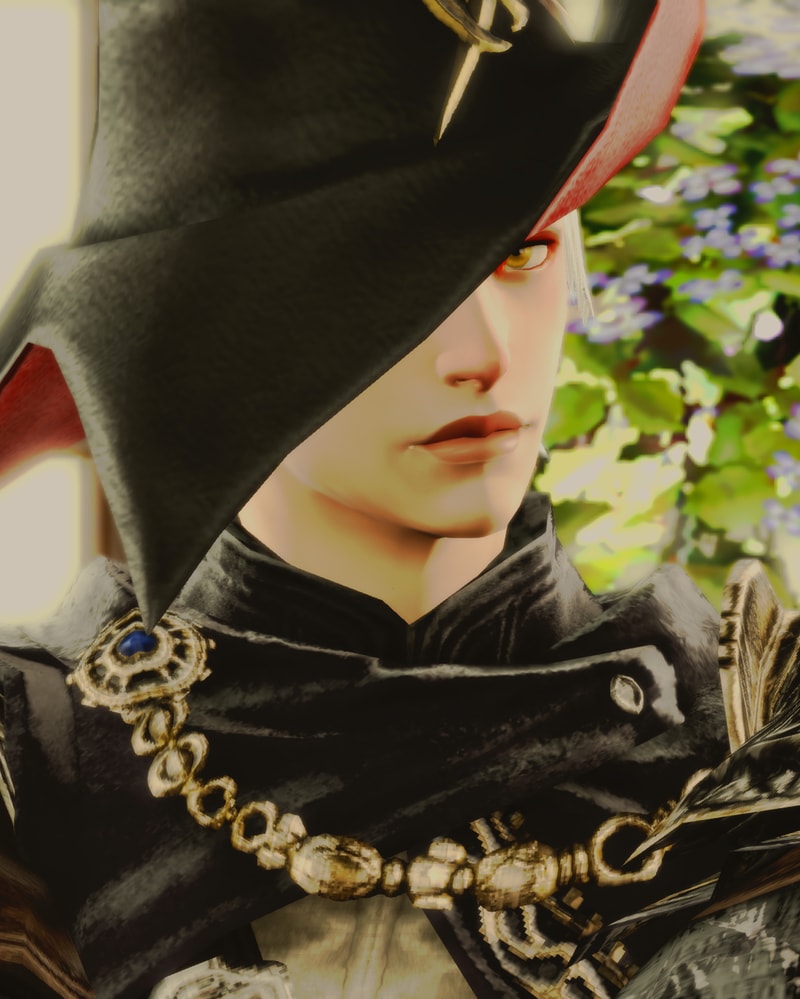
Lissome and graceful in the way water bends around stone, Rairakku's complexion is that of a pampered noble, or perhaps a courtesan. As such: flawless skin in the shade of morning dew kissed at the cheeks and forehead with the blush of sunlight, eyes ever highlighted against the waterline, dusted with creamy shadows along the fold of their eyes—eyes as alluring as pools of rare yellow wine. Their features are narrow and angular, and combined with their manner, they are an epicene beauty, their gender out of reach, their full-lipped smiles rare and knowing.
Their fashion seems to adapt to their environment, except in those instances where they don the ceremonial supple leather robes of their life at the monastery, with the collar held high as to cover their lips, hints of pale skin flashing through the garments like secret windows into the temple of light. However, the quiet, pale shadow they present themself as seems to favor neutrals, bruised plum hues, the blues of the deepest waters, and greens of high summer aspens.
Most often, they smell of strange spices, and something sweeter, like plum wine or poison or death. Disturbingly? It's not unpleasant.
—What You May Know
A Doman national who carries themself with a polite, unassuming grace, but said to possess an unearthly beauty that defies being ignored. Charming like a songbird trained within silver cages, they hurry from one conversation to the next—some people have tried to get to know them. Most all have failed.
Said pale-haired Doman is adorned in the garments of a Far Eastern religious monk—not one of Gyr Abania's chakra wielding pugilists, but a monk in the ascetic sense. They are here, some say, on pilgrimage, to study with the Hearers of the Shroud and learn for themself if the Elementals are akin to their sacred kami. Will they find this to be true? Or not? And does it matter? But they linger in Limsa Lominsa, quite a ride by airship or conventional sea travel. Perhaps they are saving up their coin.
A witch plying the quays of Limsa is said to have jabbed a finger at the Doman as they stepped off the gangplank of the trading cog making the long voyage from Kugane to Eorzea. She cried, “Death! Death!” And the sailors jeered and pantomimed over their mugs of ale at the Drowning Wench how the sea-crusted witch had clawed at her face and wept and caterwauled at the sky. Until the Doman dipped two fingers into the ashen censer swinging at their waist and painted a sign, all of gray ashes, on the witch's forehead, stilling her cries.
A mystic, too, then? Or something else?
Death?